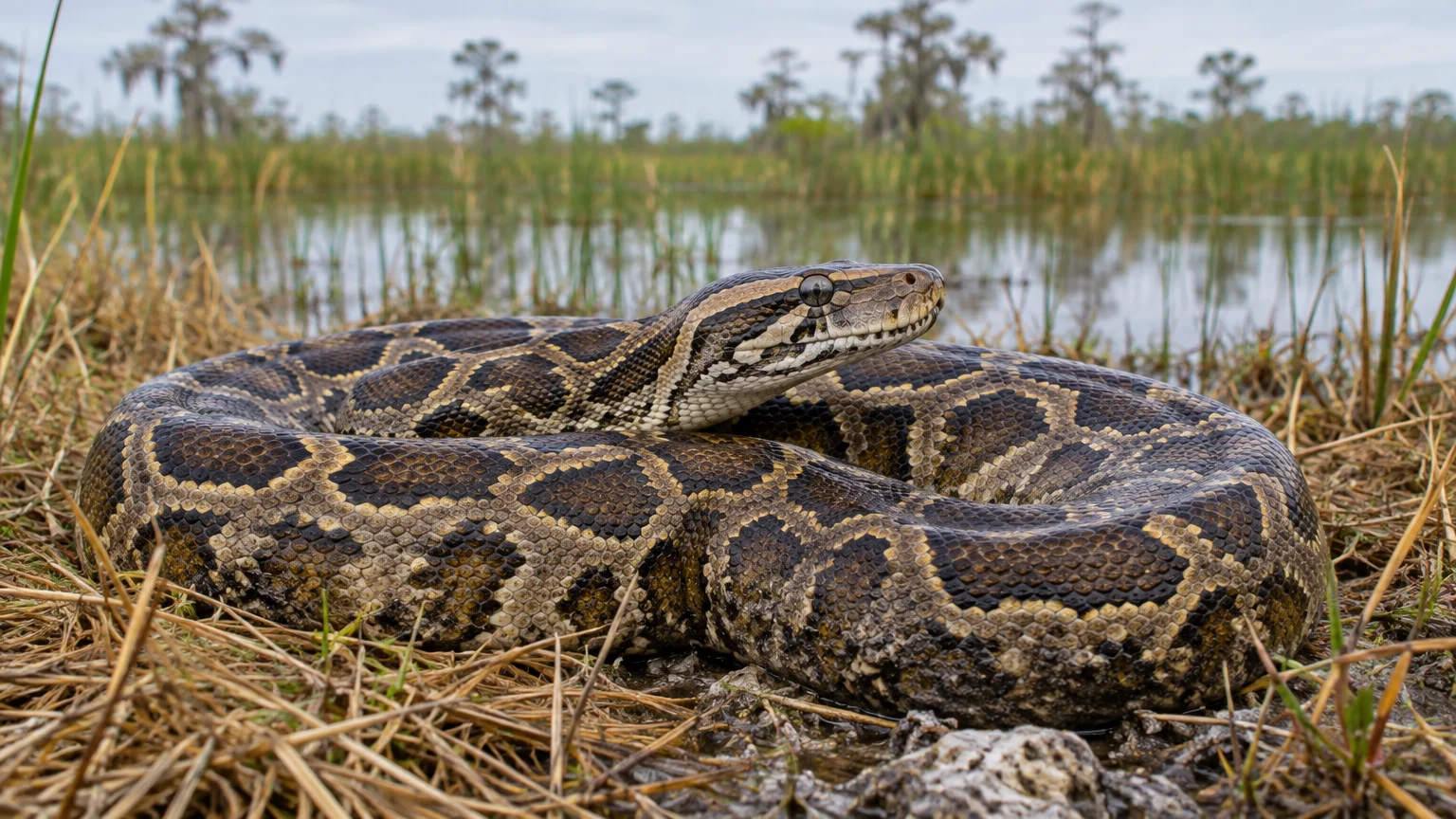
In January 2010, a record arctic blast plunged South Florida below freezing, wiping out thousands of invasive tropical reptiles. Biologists hoped the cold would permanently curb the Burmese python invasion across the Everglades.
While nine out of ten radio-tracked pythons perished, many untracked snakes survived. That ten-day freeze acted as a brutal crucible of natural selection.
Groundbreaking DNA research reveals that the survivors were not just lucky; they carried distinct genetic adaptations for cold tolerance. Today, you are witnessing real-time reptile evolution that threatens ecosystems further north.
The 2010 Arctic Blast: A Brutal Natural Experiment
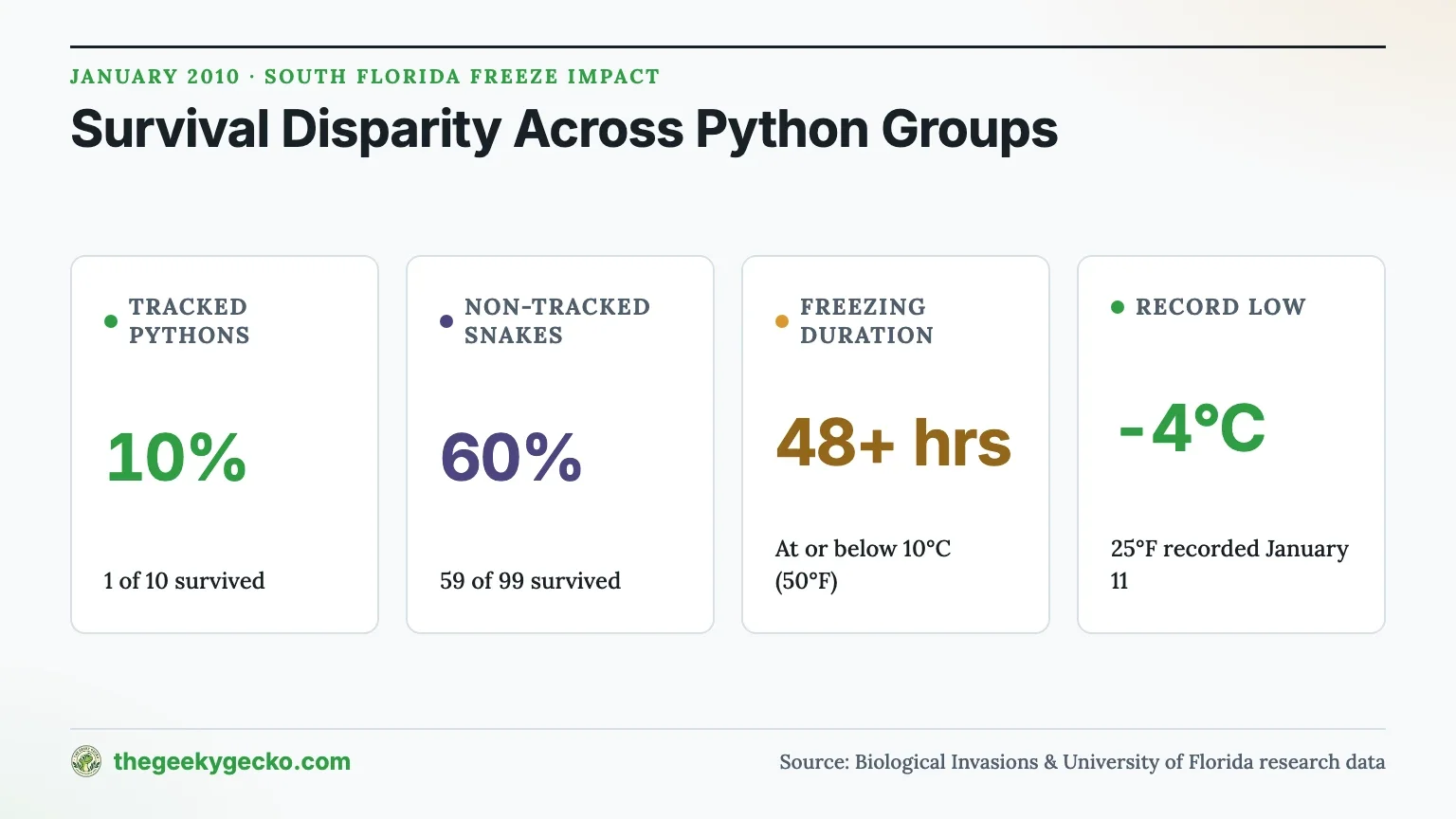
From January 2 to 11, 2010, an unprecedented cold front gripped South Florida. Air temperatures remained at or below 10°C (50°F) for over 48 hours and plummeted to -4°C (25°F) on January 11.
For tropical snakes native to Southeast Asia, this freeze was catastrophic. University of Florida researcher Frank Mazzotti tracked wild pythons throughout the cold snap to measure its impact.
A landmark study published in Biological Invasions documented that nine of ten radio-telemetered pythons died during the freeze. Several of these dead snakes displayed maladaptive behaviors, choosing to bask openly rather than retreating to deep thermal shelters.
However, the freeze did not wipe out the entire population. Among 99 non-telemetered pythons with determined fates, 59 snakes—roughly 60%—survived the frigid conditions.
This stark survival difference proved that certain individuals possessed physiological or behavioral advantages. The freeze eliminated vulnerable individuals while sparing snakes capable of withstanding the chill.
Decoding the Survivors: What the DNA Revealed
In late 2018, geneticist Daren C. Card and senior author Todd A. Castoe of the University of Texas at Arlington led an ambitious genomic investigation. Their team set out to uncover how survivors weathered the lethal temperatures.
The researchers published their findings in Molecular Ecology, examining 97 wild Burmese pythons collected across South Florida. They compared 48 snakes caught before the freeze against 49 captured several years later.
By analyzing 1,021 genetic variants across 23,041 nuclear loci, the scientists identified clear directional selection. Natural selection had altered allele frequencies across 12 candidate genomic regions containing 78 annotated genes.
These genomic regions were heavily enriched for genes regulating thermosensation, learning behavior, and responses to hypothermia. The freeze directly reshaped the genetic architecture of Florida’s python population.
Metabolism as an Internal Furnace: The Digestive Advantage
Beyond temperature sensation, the genetic analysis highlighted genes governing regenerative organ growth. Pythons possess a remarkable ability to rebuild their internal organs after consuming prey.
Within 48 hours of feeding, a python’s heart, liver, kidneys, and small intestine expand by 40% to 100% in mass. Simultaneously, the snake’s metabolic rate surges up to 40-fold.
Historical necropsies of 455 Florida pythons showed that 94.3% contained prey remains year-round. Biologists hypothesize that keeping their digestive systems active allows pythons to generate metabolic heat during sudden cold snaps.
Even with metabolic heat, extreme cold poses clear physiological limits. A comprehensive review by the U.S. Geological Survey in NeoBiota notes that pythons suffer severe exposure mortality below 10°C (50°F).
Their critical thermal minimum sits near 5°C (41°F), and temperatures around 0°C (32°F) remain lethal. Furthermore, python digestion completely stalls below 16°C (61°F), occasionally forcing snakes to regurgitate meals during cold spells.
Behavioral Shifts: Seeking Warmth Beneath the Frost
Genetics alone did not save the survivors; behavioral adaptation played an equal role. Snakes that survived learned to seek subterranean shelters before temperatures dropped.
Field researchers have observed pythons using gopher tortoise burrows, mammal dens, culverts, and canal banks. Soil 30 centimeters deep remains insulated from freezing surface air, providing a thermal sanctuary.
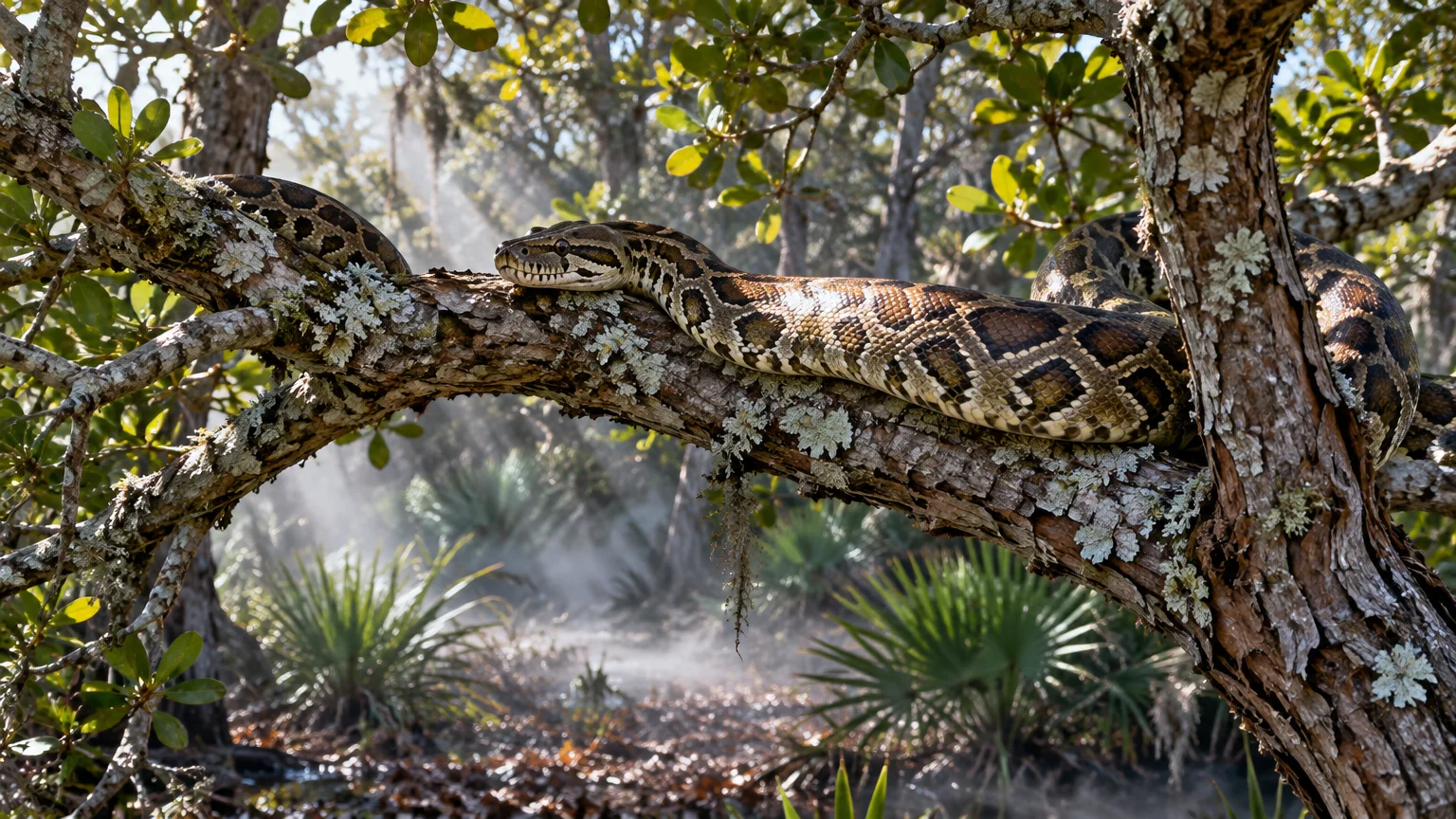
In addition to underground dens, pythons use vertical habitats to manage cold stress. A USGS tracking study of 346 pythons in Big Cypress National Preserve found that roughly 14% of adults climbed trees or shrubs, peaking during December and January.
By climbing into the canopy on sunny winter days, pythons absorb solar radiation above chilly ground-level mist. These combined behavioral strategies prevent snakes from reaching lethal internal temperatures.
Ecosystem Fallout and Northward Expansion
As pythons adapt to colder weather, their threat to native wildlife continues to mount. Since 1997, Everglades populations of raccoons, opossums, and bobcats have plummeted by 87.5% to 99.3%.
Detecting these ambush predators in the wild is extraordinarily difficult. Biologists estimate the detection probability for an individual python at less than 1% to 5%.
While robust population numbers do not exist, estimates range between 30,000 and 300,000 wild snakes. Their range is no longer confined to the southern tip of the peninsula.
The Florida Fish and Wildlife Conservation Commission confirmed an established breeding population in western Charlotte County on the Gulf Coast. Isolated individuals have even appeared as far north as Brevard County.
What You Can Do: Action and Stewardship
You play an essential role in curbing the spread of invasive reptiles. If you spot a python in Florida, report the sighting immediately using the IveGot1 mobile app.
Under rules from the Florida Fish and Wildlife Conservation Commission, you can humanely remove pythons year-round from 32 FWC-managed lands without a hunting license or permit. You may also remove them on private property with landowner permission.
Responsible pet ownership remains the cornerstone of invasive species prevention. Under Florida Statutes § 379.372, Burmese pythons are classified as a Prohibited species, banning private acquisition, breeding, and commercial sale.
At the federal level, the Lacey Act has designated Burmese pythons as injurious wildlife since 2012. You must never release any captive reptile into the wild; contact certified rehoming programs instead.
Frequently Asked Questions
Can Burmese pythons survive freezing temperatures indefinitely?
No, pythons cannot endure freezing temperatures for prolonged periods. Sustained exposure near 0°C (32°F) is lethal, and snakes require insulated burrows or warm water to survive multi-day freezes.
How far north can cold-adapted pythons spread?
Biologists monitor climate models and sightings closely. While winter freezes still restrict permanent colonization in northern states, adapted populations currently thrive across South Florida and into western Charlotte County.
Can I keep a Burmese python as a pet in Florida?
Florida law bans acquiring or breeding Burmese pythons as personal pets. Only grandfathered owners who held licenses prior to July 2010 or permitted research facilities may possess them.
How do biologists track and remove pythons during the winter?
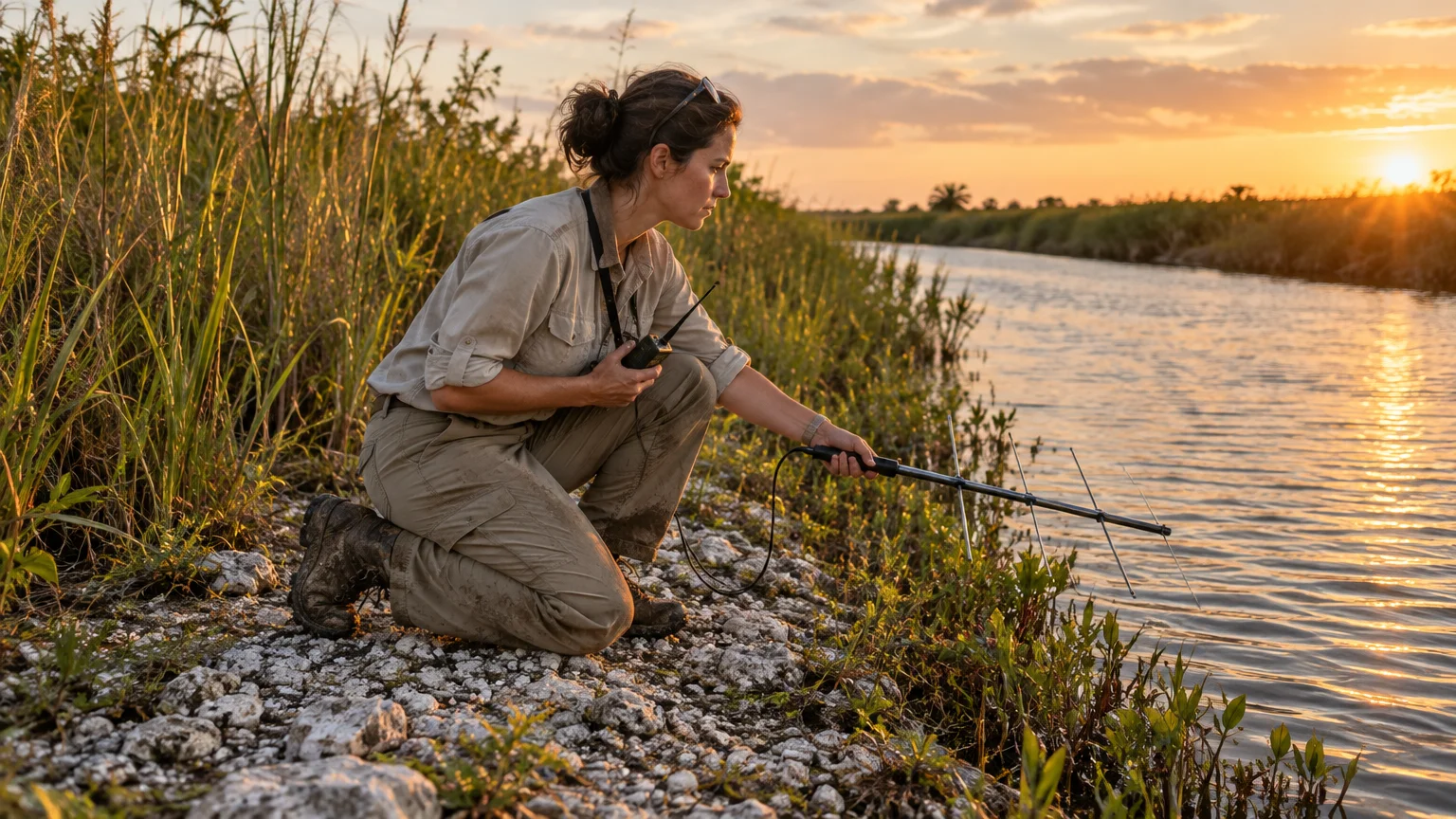
Biologists use radio-tagged male scout snakes to locate breeding aggregations during cooler months. Advanced detection tools, such as solar-powered robotic rabbit decoys with thermal cameras, also locate invasive pythons.
The Future of Reptile Adaptation in Florida
The 2010 freeze was meant to expose the geographic limits of an invasive tropical predator. Instead, it accelerated natural selection, leaving behind a lineage of pythons better equipped to navigate winter extremes.
By understanding how rapidly reptiles evolve in novel ecosystems, scientists can develop smarter eradication strategies. Your vigilance and support for native wildlife conservation help safeguard fragile ecosystems against these resilient invaders.